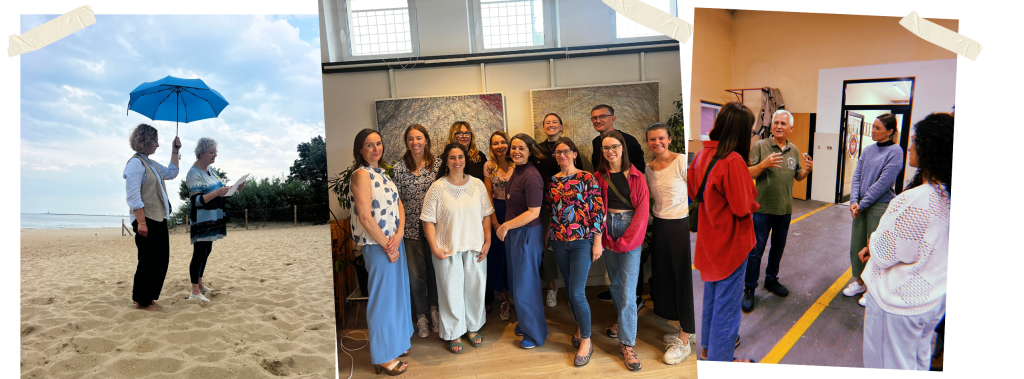
At Citizen University, we see the work of strengthening civic culture not as an abstract idea, but as something lived and practiced every day. And while our work is rooted in the United States, the questions at the heart of our project are certainly not uniquely American. Democracies around the world are grappling with similar tensions and questions:
- What creates the conditions for people to feel compelled to help shape the future of their communities?
- How do individuals come to believe their participation matters, even when they don’t see immediate results?
- What helps communities sustain trust and shared responsibility over time?
With support from the Robert Wood Johnson Foundation, CU engaged in a research and learning exchange project with partners from around the globe, exploring how civic culture is cultivated in very different political, economic, and cultural environments—and helping surface patterns that sustain democratic life anywhere.
“Friends Forever”:
What we took away from these exchanges
We began this project working with the Institute for Development Studies (IDS), a UK-based research institution that convened conversations with organizations and individuals around the world who are working to strengthen democratic participation and civic culture in their communities.
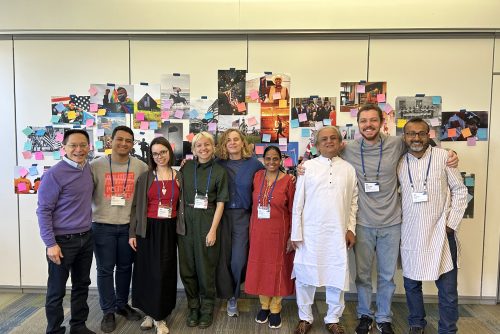
From there, we formed a learning cohort to dive deeper, made up of impactful and deeply thoughtful community organizations in:
- Poland: Society of Creative Initiatives (ę)
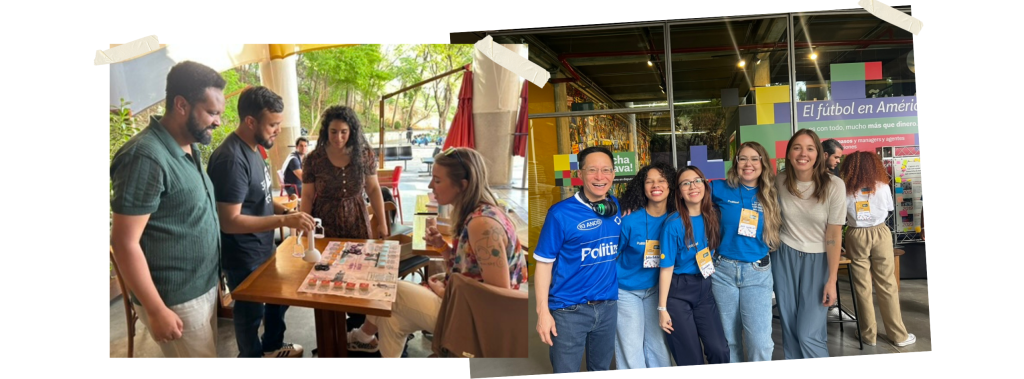
- Brazil: Politize! and Delibera Brazil
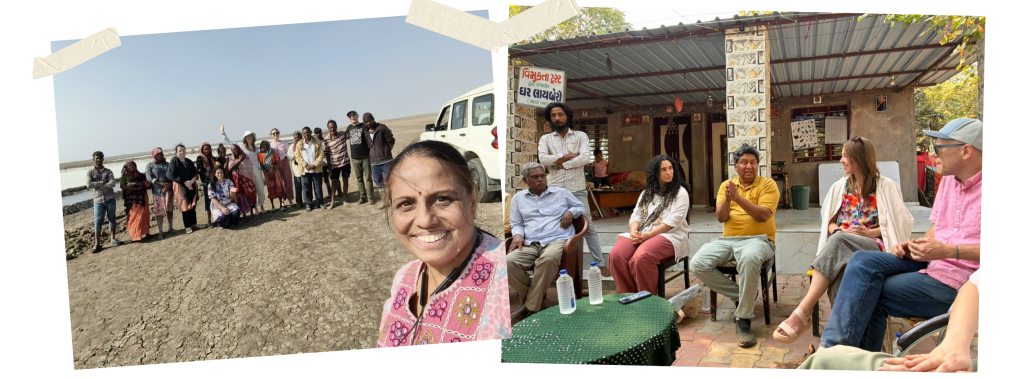
- India: Self Employed Women’s Association (SEWA) and All India Disaster
Mitigation Institute (AIDMI)
What became quickly evident as we hosted this cohort in Seattle for a week of CU programming, and then later as we traveled to each of their countries to experience their work, was the incredible spirit and pride that sustains this work among each of these organizations and many more that they work with.
Each organization held with care the distinct histories, magic, and civic pressures of their places. And yet, across all three contexts, several common patterns emerged.
1. Civic identity is formed through practice, not persuasion
One of the clearest patterns across contexts was that civic identity rarely began with abstract ideals. It started with doing something that matters alongside other people.
In India, many women come to SEWA seeking something immediate and practical—a way to earn income, access markets, or stabilize their livelihoods. Through that participation—joining cooperatives, learning new skills, contributing to shared economic systems—they begin to see themselves differently: not only as workers or beneficiaries, but as agents shaping their communities. A similar pattern appeared in Poland, where older adults organizing around transportation and safety through the Society of Creative Initiatives (ę) found that the act of designing and implementing a local solution strengthened their sense of responsibility to one another, rather than simply petitioning officials to “do something about it” from a distance. Across contexts, civic identity did not precede action, it emerged from it. Civic culture was not built by first convincing people to believe in a civic ideal, but by creating relatable atmospheres and opportunities for people to grow and act together, and allowing identity to emerge from that shared experience.
2. Participation grows when it feels useful and close to home
Across contexts, participation was strongest when people could clearly see how it connected to their immediate lives, relationships, and places.
In Brazil, we sat alongside residents from small Amazonian towns who joined together in a Citizen Assembly organized by Delibera Brazil. They responded with energy when invited not just to name frustrations or challenges, but to actively shape solutions–contributing ideas and priorities grounded in their own experiences. They were motivated by the opportunity to engage with the practical question: “What can we do here, together?” In Poland, this same instinct showed up even with less formal structures—a woman who enjoyed the free ukulele classes at a local art center asked herself what she wanted to contribute, and signed up to be a critical community anchor for immigrant families. Across contexts, participation was most durable when it was proximate, relevant, and useful. Designing pathways for civic contribution that connect directly to people’s everyday lives—where participation feels less like an obligation and more like a natural extension of how one shows up for others–felt much more possible, and meaningful, than opportunities where people had to drastically step outside of their day-to-day to take action.
3. Relationships are not peripheral to civic work. They are the work.
In each place we visited, transformational civic work depended less on polished systems or intellectual rigor, and more on relational culture.
In Poland, a gathering of Seniors in Action ambassadors unfolded with a kind of intentional looseness—participants spoke freely, facilitators followed the energy of the room, and the experience felt co-created rather than delivered. What might have appeared, on paper, as an unstructured session instead produced deep engagement and ownership. In Brazil, Politize! cultivates a similarly powerful sense of belonging through shared identity, ritual, and collective energy—participants experience themselves as part of something larger, not just attendees of a program. In India, adding ‘ben’ or sister as a suffix to every SEWA members’ name was a means of democratizing and melting class and caste distinctions. Simple, but deeply intentional. Across contexts, what enabled transformation was not the precision or intellectual rigor of the curriculum, but the quality of relationships and the emotional tone of the space. For those seeking to strengthen civic culture, this underscored that trust, warmth, and shared ownership are not soft elements of the work, they are integral to making everything else possible.
4. Civic commitment is sustained through networks, not single experiences
Finally, we were reminded that civic culture is rarely built through one transformative moment. It is sustained through ongoing networks of participation.
In India, SEWA’s impact is not the result of any single program, but of a dense, interconnected network of relationships, supports, and opportunities that women can tap into over time at different scales (local, state-wide, national, international): livelihood training, financial systems, childcare, and climate resilience tools. Each entry point builds capacity to meet immediate needs, but also connects participants into a broader ecosystem of mutual support and shared progress. As women gain from and give to this network, their sense of agency deepens, and their capacity to contribute to others grows in turn. In Brazil, Politize! similarly builds continuity through its ambassador network—participants are not just engaged once, but invited again and again to lead, create, and circulate civic practice within their own communities. We found that what sustains civic life is not a single transformative experience, but an ongoing web of participation—where small, meaningful actions are connected, examined, iterated, with this cycle repeating through relationships over time. Civic culture is strengthened when people are not only invited to act, but are embedded in networks that make continued participation possible, visible, and shared.
What We’re Carrying Forward
The lessons from this exchange are already shaping the next phase of Citizen University’s work. Some insights will influence the structure of our programs; others will inform how we think about civic ecosystems, partnerships, and storytelling.
In a moment when democratic institutions around the world face significant challenges—and when relationships between nations certainly feel strained—this project offered something both simple and profound: an opportunity for people committed to strengthening civic life to learn from one another across borders, and be reminded that many of our essential human questions are resonant across contexts. We can not say enough about the generosity and openness of our partners turned friends: Marta, Oksana, Mihir, Smita, Vishal, Marcella, Gabriel and Marcio and the many others who we met and learned from along the way, thank you. You deeply inspired us.
The questions we asked together are ones that no single organization or country can or should answer alone. But across borders, cultures, and contexts, we saw community catalysts experimenting with them every day—in classrooms, neighborhoods, cooperatives, libraries, community centers, and local networks of trust.
We leave this exchange more convinced than ever that civic renewal does not begin with perfect institutions, tight frameworks, or grand declarations, but with people practicing responsibility for one another, together, over and over again.